

The calls coming into our admissions line have changed. Not slowly, and not subtly. Over the past year, a substance our intake team almost never used to hear about has started coming up again and again — and it isn’t a street drug or a new synthetic with an alarming name. It’s something most callers first picked up off a shelf at a gas station or smoke shop, right next to the energy shots — kratom, and its far stronger relative, 7-hydroxymitragynine, better known as 7-OH.
We went back through a year of anonymized screening calls, intake forms, and staff notes to see what these callers actually sound like in their own words. A few clear patterns emerged — and they say a lot about how this substance is reaching people, and why so many are caught off guard by how hard it is to put down.
From a footnote to a flood
Start with the scale, because the scale is what got our attention.
Based on Wellbrook Recovery internal intake data.
That’s not a trend line inching upward. That’s a substance going from something we’d heard about only a handful of times, ever, to one that now comes up many times a year.
We have been witnessing a frightening surge of this potent substance wrecking people’s lives. We see an unusual desperation for help with those suffering from 7-OH dependence. Interestingly, some callers note the fact that the screws are being tightened legally on 7-OH and similar Kratom related substances is what is forcing them to reach out and get help before they feel forced to turn to street drugs to fill the gap. Chelsea Woodruff, M.A. — Director of Admissions, Wellbrook Recovery
“He doesn’t think he’s an addict”
Here’s the thread that runs through more of these calls than any other, and it’s the one worth paying the most attention to.
A striking number of callers don’t believe they have an addiction. In their eyes, they picked up a legal supplement, it got its hooks in faster than they expected, and now they just want help getting through the physical withdrawal so they can be done with it. They want detox — not residential, not a longer program. As one staff note from this year put it, a caller “wants to detox only — not willing to do res since he doesn’t think he is an addict.” Another caller, a young man named Jake, was firm on this point along with his parents: he didn’t need residential, because his addiction wasn’t “severe enough” to count.
And here’s the honest part: sometimes they’re right. A lot of these callers genuinely did have a short run with 7-OH. They found it at a store, used it for a while, and got physically dependent — and for some of them, medically supervised detox really is the main thing they need. We take that seriously. Detox is a legitimate front door, not a bait-and-switch, and we don’t think everyone who calls needs a month of residential care.
But it isn’t always that simple, either. Once dependence settles in, it tends to wreak havoc — the daily planning around the next dose, the urge for highs, the emotional crutch, rattled relationships, bad habits, secondary addictions — all the ways substances quietly remake an ordinary day. Those patterns can outlast the physical withdrawal, and they’re not always visible to the person living inside them. So our approach is to meet people where they are: start with detox when that’s what someone’s ready for, and stay honest about what we’re actually seeing. Sometimes it really was just a short, ugly chapter. Often there’s more underneath, and it’s worth exploring exactly what’s going on so that we can accomplish real recovery.
People who never saw it coming
Part of why the “I’m not really an addict” framing is so common is that so many of these callers genuinely didn’t come to 7-OH the way people usually come to a drug.
Some had never struggled with any substance before. Others had years — sometimes decades — of hard-won recovery behind them, and got blindsided by a product they never once thought of as a drug. One caller told our screener they’d been sober from alcohol since 2003, never drank again, built a whole life on it through AA — and then, in the last couple of years, “got in over my head” with what they described as “those new kratom derivatives, the alkaloids seven-oh and pseudo.” The feeling that came with it was the same hopelessness and powerlessness they remembered from active addiction. Twenty years of recovery, undone by something bought over the counter.
Another caller, years into managing an old opioid history through outpatient care, described wandering into “one of the little smoke shops” and running into 7-OH almost by accident. They weren’t looking for a new substance. They found one anyway.
This is the quiet danger of the way 7-OH is sold. It’s often labeled as “spiked” or “enhanced” kratom with no clear indication of what’s actually inside, which is part of why it’s picked up the nickname “gas station heroin.” It sits on the same shelf as vape pens and energy drinks, marketed as a natural pick-me-up, when in reality it acts on the brain’s opioid receptors more like a prescription painkiller than a supplement. Most of our callers had no idea they were taking something opioid-like until they tried to stop.
And even where the law has caught up, easy access hasn’t gone away. In Wisconsin, both kratom and 7-OH are Schedule I — illegal to possess or sell — yet it stays easy to get, with many residents simply crossing state lines to buy it.
How much are people taking? A wide — and telling — range
Most callers can give us a rough sense of how much they’re using. What’s harder — for them and for us — is landing on an exact number, and that difficulty says something important about the product itself.
7-OH comes as pressed pills and as liquid, sold under the “kratom” umbrella but really a different, far more powerful product than the natural leaf it’s named after — and made by whoever, however. One caller working out his daily dose for our screener put the problem plainly: “You can’t get exact mathematics because you’re getting these tablets that, let’s face it, aren’t exactly made in a medical laboratory.” His best answer was a number he’d reached by averaging a few days and rounding — around 200 milligrams of a 7-OH-and-“pseudo” blend, give or take fifty. A staff note on another caller put it more bluntly: “He’s getting these at the store, unregulated ‘super potent form of kratom.’”
And the range across our callers is wide, which tells you a lot about how far this can go. On the lower end, one caller estimated 100 to 200 milligrams a day. On the higher end, an intake form logged 7-OH use at 1,500 milligrams daily. That’s not a small gap — it’s the distance between a habit someone stumbled into and a deeply entrenched opioid dependence, all fed by the same legal-looking product from the same kind of shelf.
The spending tells the same story. One caller, eight years into kratom and about nineteen months into 7-OH, put their cost at roughly $325 a month. Another caller’s intake form logged $150 to $200 worth per day — well over a thousand dollars a month going to a “supplement.”
Why they finally call: the withdrawal
For most of these callers, the thing that finally drives them to the phone isn’t the using. It’s trying to stop.
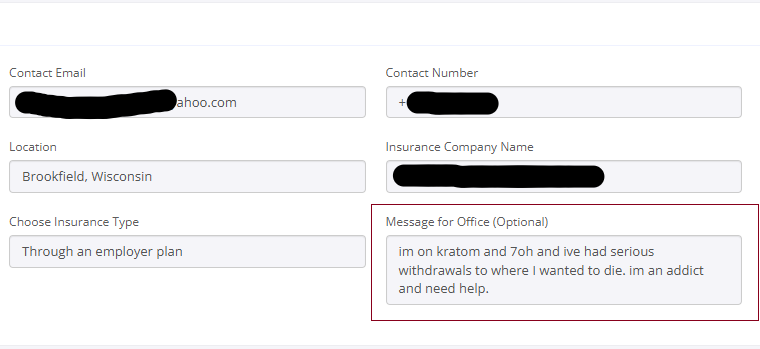
Nearly everyone describes withdrawal in the same terms: restlessness, sleeplessness, high anxiety, diarrhea, a runny nose, and more — often coming on after their own failed attempts to quit cold. One caller, using every day, said plainly they weren’t even chasing a high anymore; they were just using “to achieve kind of equilibrium.” Another, eight years into kratom use and about nineteen months into 7-OH specifically, said the hardest part was that they “can’t hardly get off it without suffering from insomnia.”
That was the whole message. Someone at the worst point of their life, describing it in a text field, and still reaching out.
Many have already tried to fix it themselves before calling, and it hasn’t held. Several were on Suboxone — sometimes prescribed, sometimes, as one recent staff note flagged, obtained illegally — and reported it simply wasn’t doing what they’d been told it would. “The Suboxone has not done what they told me that it would do,” one caller said. “Like, I feel horrible.”
This all tracks with what our own clinical team sees. Laura Browning, MSN, RN, our Director of Nursing, has watched 7-OH withdrawal up close, and in our clinical breakdown of 7-OH detox she doesn’t dress it up: “From what clients have described, this is one of the worst detoxes — one of the worst days — they have ever been through.”
How we approach it
Everything in these calls points the same direction: 7-OH withdrawal deserves to be treated with the same seriousness as any other opioid withdrawal, even though the product is sold like a supplement. That’s how our medically supervised detox handles it — around-the-clock nursing, comfort-focused care, and medication support for the physical symptoms that make people want to give up and go back.
And for the many callers who see this as a short detour rather than a long road, our answer is the same one we’d give a friend: come get through the hard part safely, let us take an honest look with you, and we’ll figure out together how much more, if any, you actually need. Nobody has to have the whole thing figured out before they call.
Just because a substance is accessible doesn’t mean it’s safe. Laura Browning, MSN, RN — Director of Nursing, Wellbrook Recovery
Think 7-OH has taken more room than you meant to give it?
The daily use just to feel normal, the withdrawal that won’t quit, the nagging sense that something you bought at a counter has taken over — you’re far from the only person calling us about it this year. Reach out, and we’ll walk you through what actually happens next, one honest conversation at a time.
Talk to our admissions team Or call anytime: (866) 986-6126Caller quotes and staff notes in this article are drawn from real Wellbrook Recovery admissions interactions and have been anonymized; identifying details have been removed or changed. This article is for general educational purposes and is not medical advice. If you or someone you love may be dependent on 7-OH, kratom, or another opioid, speak with a qualified healthcare provider.