

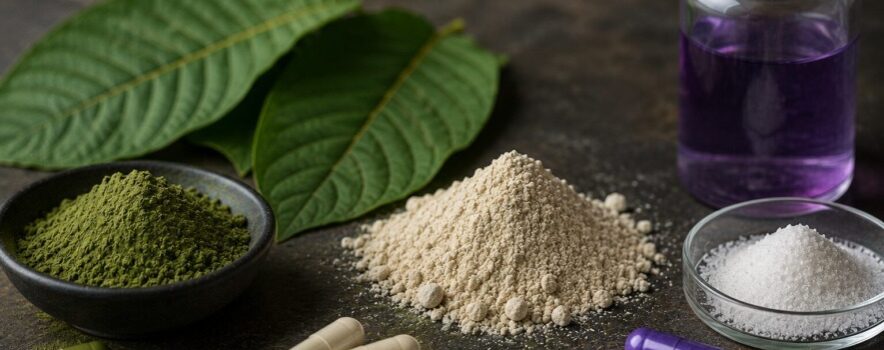
You heard about kratom. Then you started hearing about 7-OH kratom. You’re not quite sure if it’s kratom, a concentrated version, or something else entirely. Before you quite had it figured out, a new kratom product popped onto the market- MGM-15. If you’re confused about the difference between these various kratom products, you’re not alone. In this article, we explore the differences between natural kratom, 7-OH, and MGM-15.
Kratom
Kratom is a natural product derived from the leaves of the Mitragyna speciosa tree, an evergreen tree native to the tropical jungles of Southeast Asia. It has been used there for at least the last century as a traditional medicine.
In its native regions, kratom leaves are consumed as tea or chewed directly. In these countries, Kratom use is akin to drinking coffee, and users, unlike drug or alcohol users, were never looked at as low life drug or alcohol abusers.
Kratom effects
At low doses, kratom has stimulant-like effects, boosting mood and energy. At high doses, kratom’s effects become opioid-like, relaxing and sedating its users.
Many turn to kratom for its purported pain-relieving abilities, to deal with mild mental health issues, or for self-medicating opioid withdrawal symptoms.
Legal Status
At a national level, kratom is completely legal. Several states have completely banned all kratom and 7-oh substances, while others have adopted a consumer protection model- natural kratom is legal, albeit regulated, while concentrated versions, like 7-oh, are illegal.
Overdose Risks
Kratom has been identified in overdose deaths, but usually in conjunction with other substances. However, even in polydrug cases, kratom’s contribution to respiratory depression cannot be ruled out. Kratom has also been identified as the single cause of overdose deaths.

High dose: sedation, pain relief
7-OH
Sometimes called legal morphine or gas station heroin, 7-hydroxymitragynin (7-OH) is a rising health concern today. It’s produced by synthetically producing the most potent alkaloid (chemical) in kratom leaves with the resulting product being tens of times stronger than kratom leaves in their natural form. It’s often marketed as spiked, or enhanced kratom, while in truth it’s an addictive, opioid-like substance.
7-OH effects
7-OH acts on opioid receptors in the brain and produces opioid-like effects, including sedation and respiratory depression. Withdrawal symptoms include muscle aches, restlessness, anxiety, insomnia, nausea, sweating, chills, diarrhea, mood changes, and intense drug cravings.
Users typically take 7-oh for the same reasons they were using kratom- for pain relief, mood boosting, or to self-medicate opioid withdrawals.
Legal status
The FDA has requested that the DEA schedule, or declare 7-OH illegal. The process to schedule 7-OH is underway, and as of October 22, 2026, the DEA has announced that the scheduling of 7-OH can take effect on or after November 13, 2026. Read the current legal status of 7-OH for more info.
Addiction and overdose risks
Because 7-OH activates opioid receptors, it is an addictive substance. In the past year, Wellbrook Recovery has seen an 800% increase in 7-OH related admission inquiries, (based on internal intake data) highlighting the prevalence of the addiction.
Additionally, while few hard numbers exist, 7-OH is repeatedly being cited across the news as a main driver in overdose deaths.
7-OH vs. kratom
Isolated 7-oh can be 500 times stronger than natural kratom leaf. The resulting product is a dangerous opioid product, while kratom is a natural botanical product. 7-OH is not more of kratom, it’s a completely different product that happens to occur naturally in trace amounts in kratom leaf.
MGM-15
MGM-15, also known as dihydro-7-hydroxymitragynine, is a synthetic derivative of 7-OH. It’s created by chemically modifying 7-OH to increase its’ strength and potency. Structurally, MGM-15 is a modified version of 7-OH. It is a full opioid agonist, and binds to opioid receptors in the brain more strongly than 7-OH products.
MGM-15 effects
In animal studies, MGM-15 produces opioid effects. Because MGM-15 is a full opioid agonist, it is expected to carry opioid-associated risks including dependence, addiction, and respiratory depression, consistent with its pharmacological profile.
Legal status
In early July, the DEA filed a notice of intent to federally schedule MGM-15. The rule went into effect on August 26, 2026. Since then, MGM-15 and similar potent 7-OH “derivative products” are illegal in all areas of the United States.
On a state level, several states had scheduled MGM-15 months prior to the federal ban, and others have taken steps to restrict sales. See the legal status of MGM-15 for more details.
MGM-15 vs. 7-OH
While 7-OH is a compound naturally found in kratom leaf, MGM-15 is not. It is a completely synthetic opioid, only it’s modeled after the chemical structure of 7-OH. MGM-15 is 2.6 to 3.4 times more potent than 7-OH.
In Summary- The difference between kratom, 7-OH, and MGM-15
Differences
- Kratom is the parent product, a natural plant.
- 7-OH is a compound found in trace amounts in kratom
- MGM-15 is a semi-synthetic opioid created by chemically altering the structure of 7-OH.
Similarities
- All substances pose risks of dependence, addiction, overdose, and overdose death, in varying degrees.
- All three substances are widely available in gas stations, smoke shops, and online wellness stores.
- All three substances were legally available in many areas of the United States. Since the scheduling of MGM-15, and with the expected scheduling of 7-OH, that has changed.
FAQs
No. 7-OH is a compound found in trace amounts in kratom leaf, but the 7-OH products sold commercially are concentrated or synthetically produced. The result is up to 500 times stronger than natural kratom leaf and carries full opioid-like risks that kratom does not.
No. MGM-15 is a semi-synthetic opioid modeled after the chemical structure of 7-OH. It is not found in kratom leaf and has no natural origin. It is sold alongside kratom and 7-OH products but is a distinct and more potent substance.
Yes. MGM-15 is 2.6 to 3.4 times more potent than 7-OH at opioid receptors, and approximately 50 times more potent than morphine in animal studies.
Yes. 7-OH is up to 500 times stronger than natural kratom leaf. While both act on opioid receptors, kratom’s effects are mild compared to 7-OH, which carries the full addiction and overdose risks of a potent opioid.
Are you ready to be given a new chance at health and happiness? Be your true best self? Has going it alone not been working? Perhaps you’re concerned about a loved one and want to support them in obtaining the help they need to get better?
Wellbrook Recovery has extensive experience and expertise assisting individuals with all types of substance abuse struggles. Providing compassionate and cutting-edge, multi-pronged addiction recovery care at our beautiful, upscale facilities.
Our highly regarded, expert team of multi-licensed therapists and specialists will make your success their own and will hold your hand throughout, regardless of where you currently at. We’ve done it hundreds of times, helping individuals and families reclaim their lives, their confidence, and their smiles.
Just reach out.
We’ll walk you through the simple admission process and answer any and all questions.
We understand that addiction affects everyone differently, which is why we offer a range of treatment options designed to meet your individual needs. Our treatment center provides the following programs:
Drug & Alcohol Detox: Detoxification is often the first step in recovery. Our facility provides medically supervised detox to help clients safely manage withdrawal from drugs or alcohol in a supportive environment.
Inpatient Drug Rehab: Inpatient treatment offers a structured environment so clients can focus on recovery free from distractions. It’s ideal for those at the beginning of their recovery journey who need intensive, around-the-clock care to overcome addiction.
Day rehab – Partial Hospitalization Program (PHP): As clients transition from inpatient care to a more independent lifestyle, PHP gives them the support they need as they continue on their road to recovery. By spending much of the day in rehab but the evenings at home, clients reinforce the life and recovery skills they learned during inpatient treatment.
Outpatient Treatment Programs (Day/Evening): For those who need more flexibility, outpatient programs allow clients to continue living at home while attending treatment on a part-time basis.
Wellbrook Recovery believes in treating the whole person, not just the addiction. Our services go beyond detox and inpatient care to ensure a complete recovery process:
- Mental Health Support: Addiction often co-occurs with mental health disorders such as anxiety, depression, trauma and PTSD. Our team of mental health professionals works closely with clients to treat both the addiction and any underlying mental health issues.
- Behavioral Therapy: We utilize proven behavioral therapies such as CBT, DBT, IFS, EMDR, Biofeedback, Music Therapy, Art Therapy, among other advanced therapies to help individuals address the root causes of addiction, develop coping skills, and make lasting changes in their lives.
- Support Groups: Our support groups provide individuals with the opportunity to connect with others who are going through similar struggles. Peer support is an essential part of the recovery journey.
- Family Programs: Addiction impacts not only the individual but also their loved ones. Our family programs educate and support families, helping them to rebuild relationships and provide ongoing support.
- Alumni & Aftercare: We have a network of our close-knit alumni community, with events and support to stay in touch with your recovery and “battle brothers & sisters” from your time in treatment.