One of the biggest challenges in overcoming addiction is finding the motivation to change. Motivational Interviewing (MI) helps individuals struggling with substance use explore their own reasons for making positive changes, rather than relying on external pressure. At WellBrook Recovery, this approach helps clients lower defensiveness and discover personal motivation that drives lasting recovery.
Table of Contents
- Key Takeaways on Motivational Interviewing for Substance Abuse
- What Is Motivational Interviewing?
- The Benefits of Motivational Interviewing for Addiction
- What Are the Four Processes of Motivational Interviewing?
- OARS: The Primary Method Behind Motivational Interviewing
- Motivational Interviewing Questions for Substance Abuse
- Frequently Asked Questions on Motivational Interviewing for Addiction
Key Takeaways on Motivational Interviewing for Substance Abuse
- Motivational Interviewing for substance abuse is a collaborative counseling approach that helps someone work through mixed feelings about change instead of pushing them into it.
- It’s considered evidence-based and is widely used in substance use disorder treatment, especially when someone is unsure, resistant, or overwhelmed.
- Motivational Interviewing typically moves through four processes: engaging, focusing, evoking, and planning, which don’t always happen in a straight line.
- In sessions, people often experience MI through a calm, respectful style that includes open-ended questions, affirmations, reflective listening, and summaries (often called OARS).
- Families can benefit from understanding MI because it explains why “lectures” and pressure often backfire, and why a different tone can lead to better engagement in treatment.
What Is Motivational Interviewing?
Motivational Interviewing is a person-centered, goal-directed approach that helps people resolve mixed feelings about change. It’s designed to reduce resistance and bring out a person’s own motivation, rather than relying on pressure, arguments, or guilt.
Motivational Interviewing is a structured approach that doesn’t “just be nice” and doesn’t avoid hard topics. It’s a method for having hard conversations that keep the person engaged. According to SAMHSA’s guidance on Motivational Interviewing, collaboration is central to the process, which is why individuals are not pushed or pressured, and change is supported in a respectful, client-centered way that honors readiness and personal choice.
If you’re supporting someone with addiction, this can be a relief to hear. Many families have already tried intensity: ultimatums, long talks, repeated reminders, and pleading. Motivational Interviewing offers an alternative approach allowing individuals to feel supported rather than cornered. Creating a non-confrontational environment helps people share their thoughts and experiences more willingly.
The Benefits of Motivational Interviewing for Addiction
Motivational Interviewing can help with one of the most common barriers to recovery: the gap between knowing something is wrong and feeling ready to change it. In addiction, that gap is often filled with shame, fear of withdrawal, fear of failure, fear of losing a coping tool, or fear of what life will look like sober.
Research overall supports MI as an effective approach for substance use reduction and behavior change, even though outcomes can vary based on setting and how MI is delivered.
Some of the improvements people experience include:
- Less arguing and less “power struggle” in sessions
- More honest talk about cravings, triggers, and consequences
- Clearer personal reasons to pursue sobriety (parenting, health, relationships, freedom)
- Better follow-through when a plan is chosen, because it feels owned rather than imposed
MI doesn’t replace medical detox and rehab programs, it complements them. At WellBrook Recovery, we often integrate MI alongside other therapies so a person can build both motivation and practical skills for staying sober.
What Are the Four Processes of Motivational Interviewing?
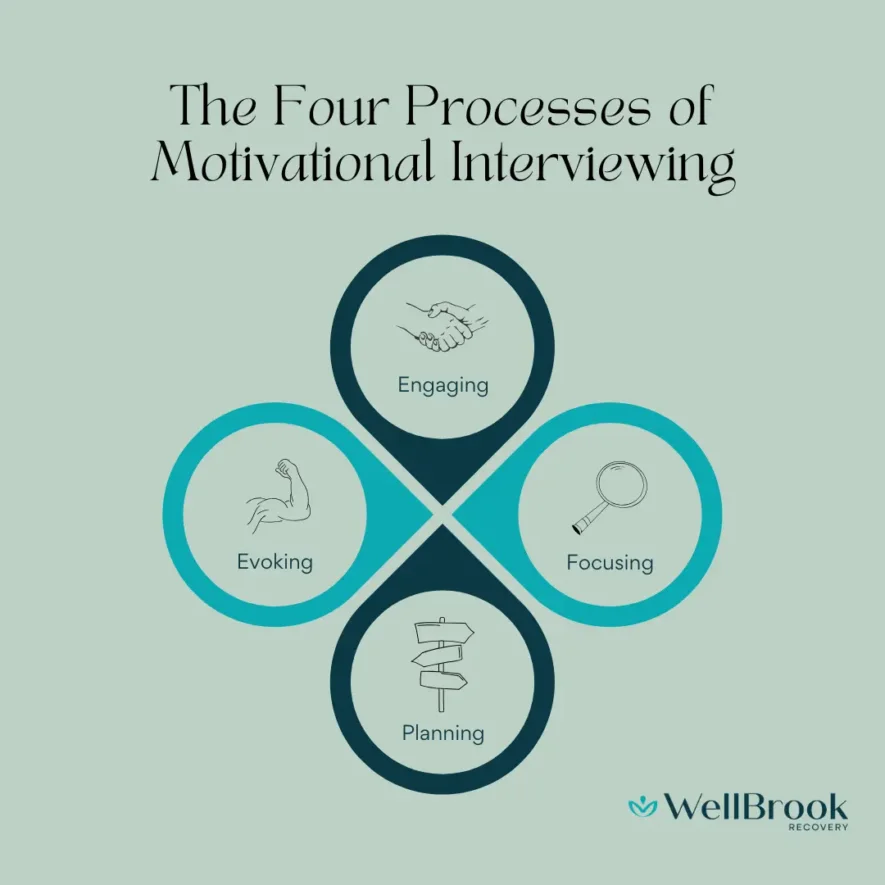
Title: Infographic about the Four Processes of Motivational Interviewing
Alt: The four processes of Motivational Interviewing can help individuals overcome hurdles in addiction treatment.
Motivational Interviewing is commonly described through four processes:
- Engaging
- Focusing
- Evoking
- Planning
These processes can loop, pause, and repeat. That flexibility is part of what makes MI work with substance abuse, where confidence and willingness can swing day to day.
- Engaging: Establishing Trust in Motivational Interviewing
Establishing a safe, non-judgmental connection helps individuals open up about their substance use and experiences. This foundation of trust makes it easier to explore challenges and start the recovery journey. In MI, this is where a person stops bracing for judgment. The therapist remains direct when needed, but the tone remains collaborative.
From the client’s perspective, this often feels like being listened to without being treated like a problem to fix. That might sound small, but for someone who has been criticized, doubted, or labeled for a long time, it can be the first time they stay in the conversation long enough to consider change.
- Focusing: Identifying the Root Causes of Addiction
This Motivational Interviewing step helps individuals identify the aspects of their life and behavior they most want to change, such as reducing substance use, improving relationships, or addressing underlying trauma. Instead of trying to fix everything at once, MI helps identify what matters most right now and what change target makes sense.
Families often hope the primary focus of therapy will be on stopping substance use entirely. While that is sometimes the case, the immediate focus is often directed toward stabilizing the factors that make ongoing treatment possible. This can include attending sessions consistently, establishing regular sleep patterns, reducing exposure to risky situations, or addressing underlying mental health concerns that may contribute to relapse.
- Evoking: Finding Inner Motivation for Change
In Motivational Interviewing, evoking involves helping the individual explore and articulate their own reasons for change, encouraging reflection on how their behaviors impact their life, and strengthening statements that support commitment to recovery. This is where you’ll often hear statements shift from “I have to” to “I want to,” or from “nothing works” to “I’m tired of living like this.”
A client might explore what they value (being present with kids, staying employed, feeling physically well) and then look at how substance use conflicts with those values. This isn’t done to shame them but to help them see the discrepancy clearly enough that motivation grows from the inside.
- Planning: Creating a Personalized Recovery Path
Planning involves creating actionable steps to achieve recovery goals, including coping strategies, support systems, and professional guidance. Planning transforms motivation into practical, sustainable change.
For families, planning can also include boundaries and communication expectations, because recovery affects the whole household. The plan is more durable when it includes realistic support and clear limits.
OARS: The Primary Method Behind Motivational Interviewing
You’ll often hear MI described through OARS, which stands for Open questions, Affirmations, Reflective listening, and Summarizing. Here’s how each component of OARS is applied in practice during a session:
- Open questions: Instead of “Do you want to quit?” you’ll hear questions that invite a fuller answer, ‘like what matters to you’, ‘what worries you’, and ‘what do you want your life to look like’.
- Affirmations: These are specific acknowledgments of strength or effort, not flattery. A person might hear, “You showed up even though you didn’t want to,” or “It took courage to say that out loud.”
- Reflections: The therapist repeats back the meaning, not just the words. This helps the person feel understood and often helps them hear themselves more clearly.
- Summaries: The therapist pulls together key points so the person can confirm what’s true and choose what they want to do next.
Motivational Interviewing Questions for Substance Abuse
In MI, questions are used to help someone explore their own reality, not to trap them or prove a point. For the person receiving therapy, these questions can feel surprisingly straightforward because they focus on lived experience.
Here are examples of the kinds of questions a client might encounter in Motivational Interviewing for addiction:
- What do you like about using and what do you not like about it?
- When have you felt most worried about your substance use?
- If nothing changed over the next year, what would you expect your life to look like?
- What are you hoping treatment could help you get back?
- What would make change feel worth it, even if it’s hard?
- When have you handled something difficult without using, even once? What helped?
For families, the important part is the goal behind the questions: helping the person say their own reasons out loud. That’s different from being told what their reasons should be.
Building Strong Foundations for Recovery with Motivational Interviewing
Motivational Interviewing can bring about meaningful change if you’re struggling with substance use disorders. At WellBrook Recovery, our treatment plans are guided by your individual needs. We offer a variety of therapies that work together to create a holistic approach to addiction, and we are committed to using only the best evidence-based practices. Our goal is to address every aspect of addiction and not just the symptoms, but the underlying causes.
Don’t hesitate to reach out. Whether it’s for you or a loved one, we are here to listen and provide support.
Frequently Asked Questions on Motivational Interviewing for Addiction
What is the primary goal of Motivational Interviewing?
The primary goal is to strengthen a person’s own motivation and commitment to change by exploring ambivalence in a respectful, collaborative way.
Is Motivational Interviewing evidence-based?
Yes. MI is widely recognized as an evidence-based approach and is included in major substance use disorder treatment guidance, including SAMHSA resources.
What does Motivational Interviewing help with?
Motivational Interviewing helps with readiness for change, treatment engagement, and reducing resistance, especially when someone feels unsure, defensive, or overwhelmed about stopping alcohol or drugs.
Does Motivational Interviewing work for addiction?
Yes, it can. Research generally supports MI as helpful for reducing substance use and supporting behavior change, though results can vary by individual and setting, and it’s often most effective as part of a broader treatment plan.
Is Motivational Interviewing something I can do outside of therapy?
While working with a professional is ideal, self-directed practice or virtual sessions can also be effective. Here’s how to do Motivational Interviewing at home:
Follow core techniques such as open-ended questions, affirmations, reflective listening, and summarizing. Use a quiet space, practice empathy, and guide change talk in the process.
Does Motivational Interviewing differ for alcohol and drug abuse?
The main difference between Motivational Interviewing (MI) for alcohol and drug abuse lies in the client’s readiness and specific substance-related behaviors. MI adapts to each substance by addressing unique triggers, consequences, and treatment goals. The core techniques remain consistent across both but are tailored to individual contexts. For example:
Motivational Interviewing for alcohol use may focus on social drinking triggers like peer pressure, while Motivational Interviewing for drug addiction often targets relapse risks related to withdrawal or criminal behavior.