

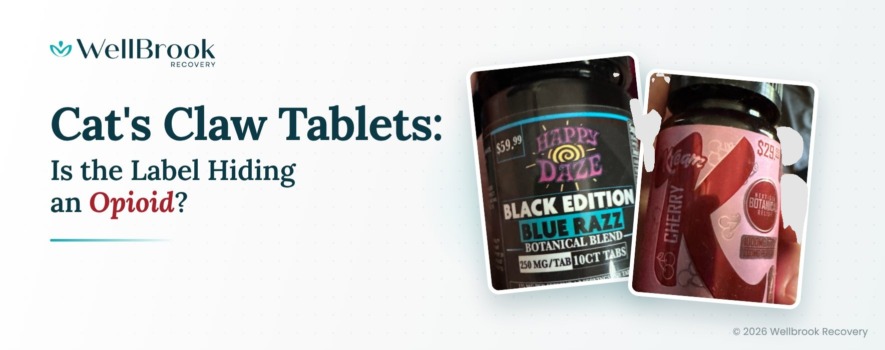
A man called our Ohio admissions line looking for a bed. He had gotten off 7-OH, the potent kratom-derived opioid sold in gas stations and smoke shops. Since then, he'd been taking two different brands of "cat's claw" tablets, both labeled as containing no 7-OH. He's convinced they're hiding something. They get him high, he told us, and when he stops, the withdrawal is strong.
He has reason to suspect it. Since July 2026, health officials in at least four states have found kratom-derived opioids hidden in products sold as cat's claw, and Utah has linked four deaths to them.
He sent us photos of both bottles. Here's what the labels show, what's been found in similar products, and what to do if you're taking them.
About this article: We are not saying that Happy Daze, Kream, or any other specific product is mislabeled, adulterated, or misleading. We have not tested these products and have no lab results for them. This article looks at the labels in photos a caller sent us, his own account of his experience, and published reports from health officials about other products sold as cat's claw. Its purpose is to inform, not to accuse.
What is cat's claw?
Cat's claw is a woody vine that grows in the Amazon and other tropical parts of Central and South America. Most cat's claw supplements sold in the U.S. use the species Uncaria tomentosa. It's usually marketed for joint pain, arthritis, and immune support, though the evidence for those uses is limited (NCCIH).
Can cat's claw get you high?
No. Genuine cat's claw is not psychoactive. Poison centers have said plainly that real cat's claw doesn't cause an opioid high, opioid overdose, or opioid withdrawal. If a product sold as cat's claw is giving someone a buzz and a hard comedown, the cat's claw is not the likely cause.
Are cat's claw tablets laced with 7-OH or kratom?
Some have been. Since this summer, "cat's claw" has become one of the most common disguises for kratom-derived opioids. (If you're new to the topic, our guide to everything you need to know about kratom covers the plant itself.)
- Utah: In July 2026, the Utah Poison Control Center warned about cat's claw and kava blends sold in smoke shops and online after multiple reports of severe overdoses. It named the brands Buzzers and Homiez and said others may be involved (Utah Poison Control). State testing of Buzzers Cat's Claw tablets found mitragynine pseudoindoxyl and MGM-15, two opioid-acting compounds derived from kratom (Utah Department of Agriculture and Food). In October, Utah health officials linked four deaths to these compounds in products labeled as cat's claw (TownLift).
- Tennessee: The Tennessee Bureau of Investigation reported 18 cases since July in which tablet packs labeled cat's claw turned out to contain kratom compounds, including some that didn't list kratom at all (NewsChannel 9).
- Virginia: In September, the Virginia Department of Health warned that poison centers had flagged cat's claw products containing unlabeled kratom alkaloids and synthetic derivatives, including 7-OH (VDH).
- Washington: On October 6, the Washington Poison Center warned that counterfeit cat's claw spiked with concentrated kratom compounds was causing opioid overdoses and severe withdrawal (KIRO 7).
The products have turned up in vape shops, gas stations, convenience stores, and online (Becker's Behavioral Health). Utah Poison Control advises against buying cat's claw products marked "adults only" or "21+," or anything marketed as legal while promising a psychoactive effect. Our article on gas station heroin covers the wider category of shelf products that act like hard drugs, including tianeptine.
What's on the Happy Daze and Kream labels?
Our caller sent photos of two products: Happy Daze Black Edition (Blue Razz) and Kream (Cherry). We can't test his tablets, and as of this writing no health agency has named either brand. What follows is our reading of the labels as they appear in his photos. Several details stand out, and some of them raise questions, but none of them shows what is actually in the tablets.
| Happy Daze Black Edition | Kream Cherry | |
|---|---|---|
| Main ingredient | Uncaria tomentosa extract (cat's claw), 125 mg | Uncaria tomentosa (cat's claw), 37.5 mg |
| Other ingredients | Quercetin 100 mg, urolithin A 100 mg, L-theanine 75 mg, vitamin C 30 mg, vitamin B6 5 mg | Picralima nitida (akuamma) 6.25 mg, kanna 6.25 mg |
| Serving | 1/2 tablet, 20 servings, 10 tablets | 1/4 tablet, 16 servings |
| 7-OH claim | "0 Parts Per Million" on a dry weight basis | "Contains no 7-hydroxymitragynine" |
| Other markings | "Scan for COA," kratom-style alkaloid footnote | "21+," "Third Party Lab Tested," "Rapid Release Formula" |
| Price | $59.99 | $29.99 |
Happy Daze Black Edition: what stands out on the label
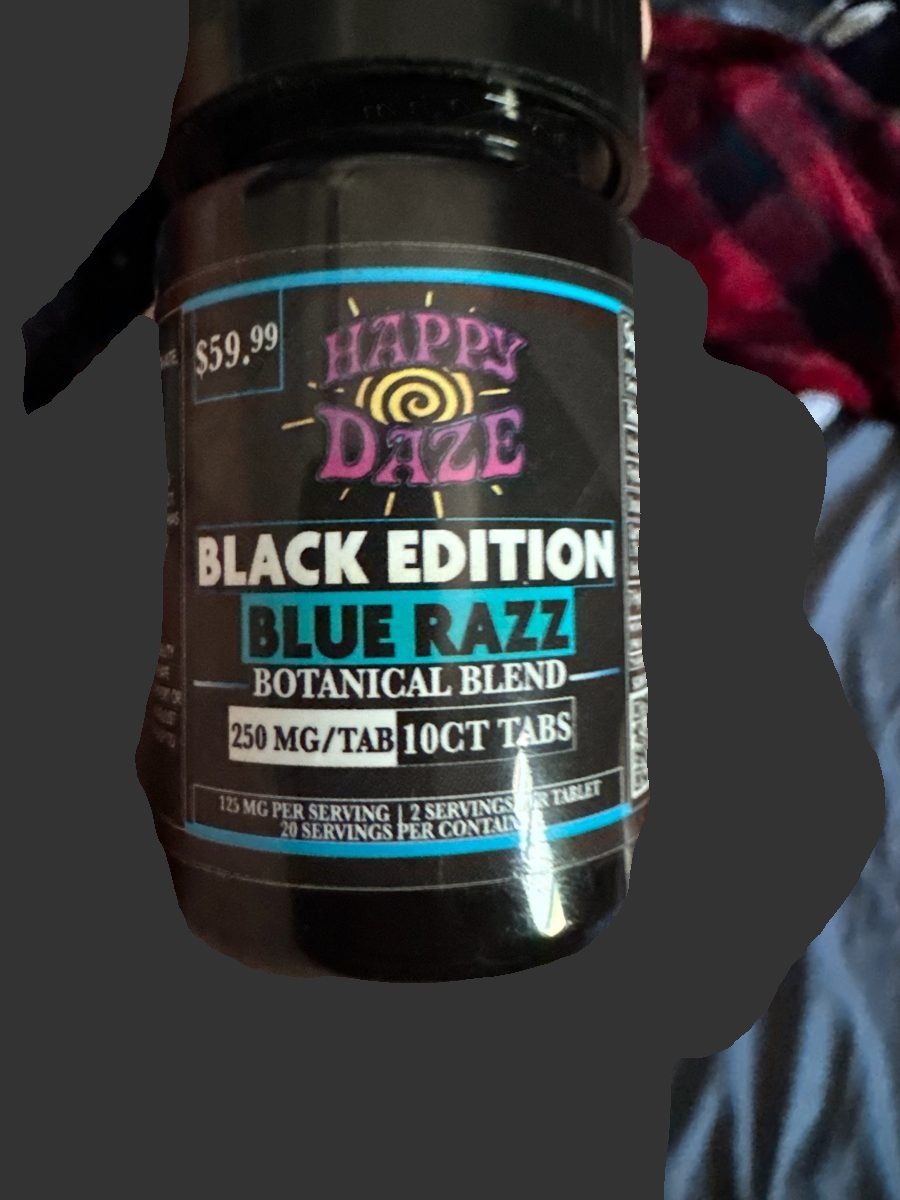
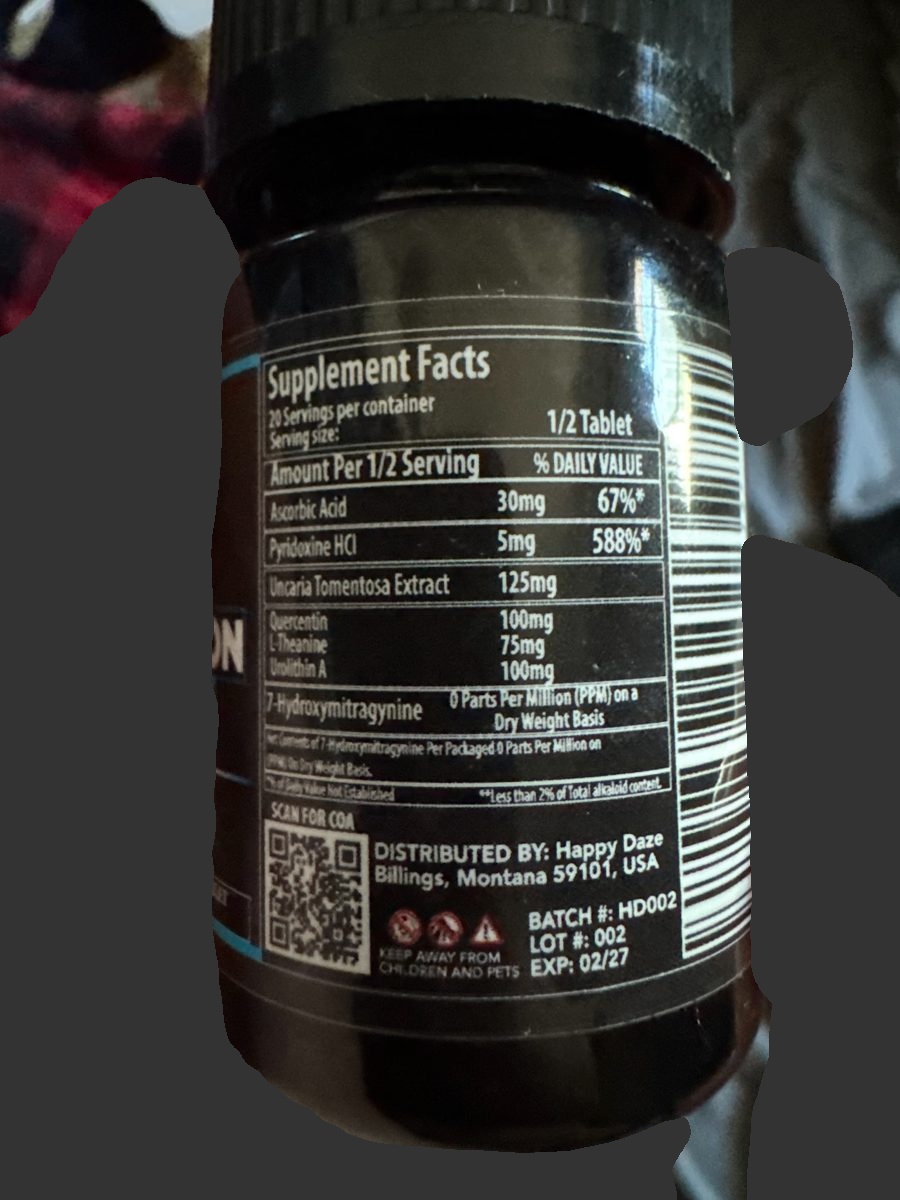
The headline number only counts the cat's claw. The front says 250 mg per tablet, or 125 mg per serving. That matches the cat's claw line and nothing else. Add up everything on the panel and a serving holds about 435 mg of listed ingredients. The product is sold by its cat's claw milligrams, the way 7-OH tablets are sold by their 7-OH milligrams. That's our reading, but it's an odd way to sell an herb that normally comes in inexpensive capsules.
The vitamin math is wrong. The FDA's Daily Value for vitamin C is 90 mg and for vitamin B6 is 1.7 mg (FDA). So 30 mg of vitamin C is 33% of the Daily Value, but the label says 67%. Five milligrams of B6 is about 294%, but the label says 588%. Both are exactly double. The vitamins are also marked with an asterisk that points to "% of Daily Value Not Established," which is incorrect, since both vitamins have established Daily Values.
It uses kratom labeling. The panel reports 7-hydroxymitragynine in parts per million on a dry weight basis, and a footnote reads "less than 2% of total alkaloid content." That 2% figure is the kratom industry's threshold for natural 7-OH levels in kratom. Cat's claw, quercetin, theanine, urolithin A, and vitamins have nothing to do with kratom. A real cat's claw supplement has no reason to report 7-OH at all. From the photos, we couldn't clearly connect the 2% footnote to any ingredient on the panel.
The lab report may not answer the question. The bottle has a "Scan for COA" code linking to a certificate of analysis. A "0 PPM 7-OH" result shows they tested for 7-OH. It doesn't show whether they tested for anything else, which matters a great deal, as explained below.
Kream Cherry: what stands out on the label
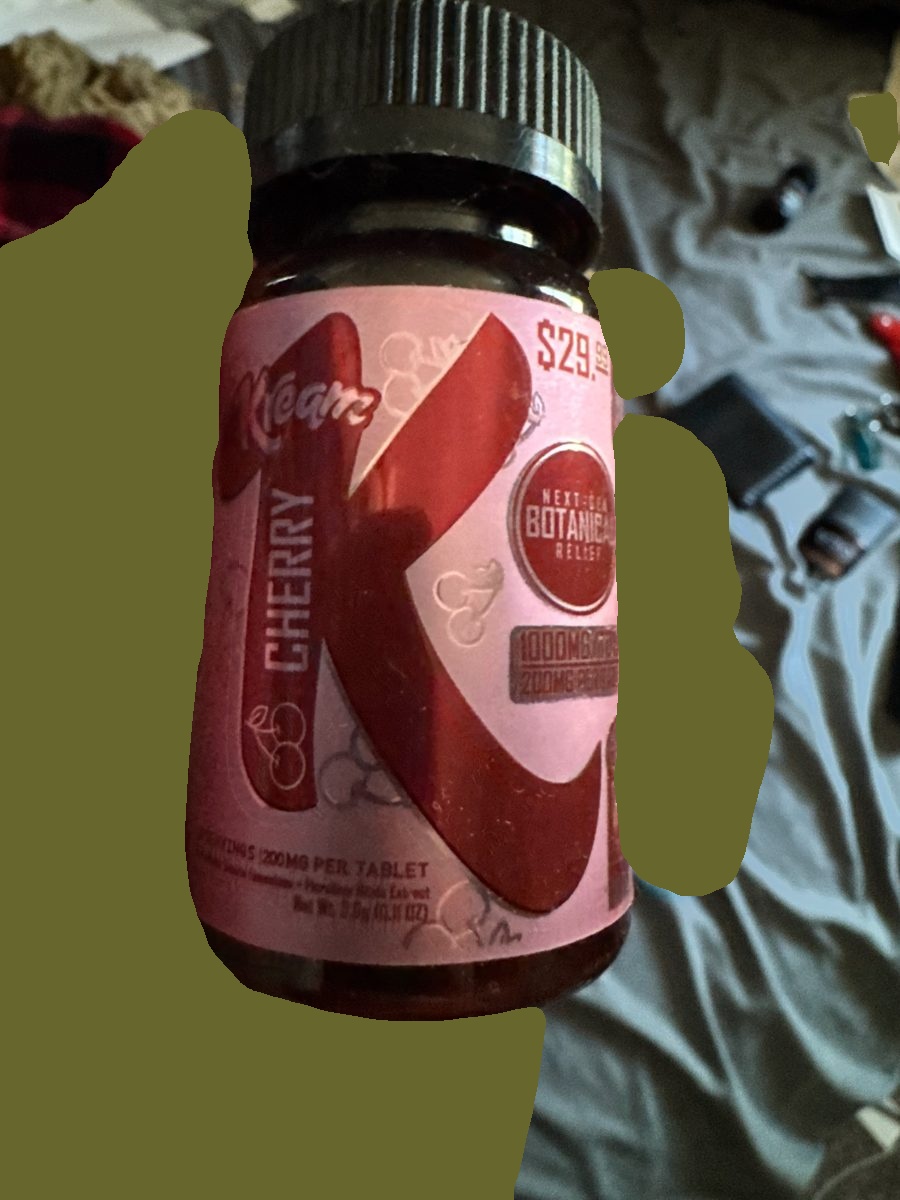
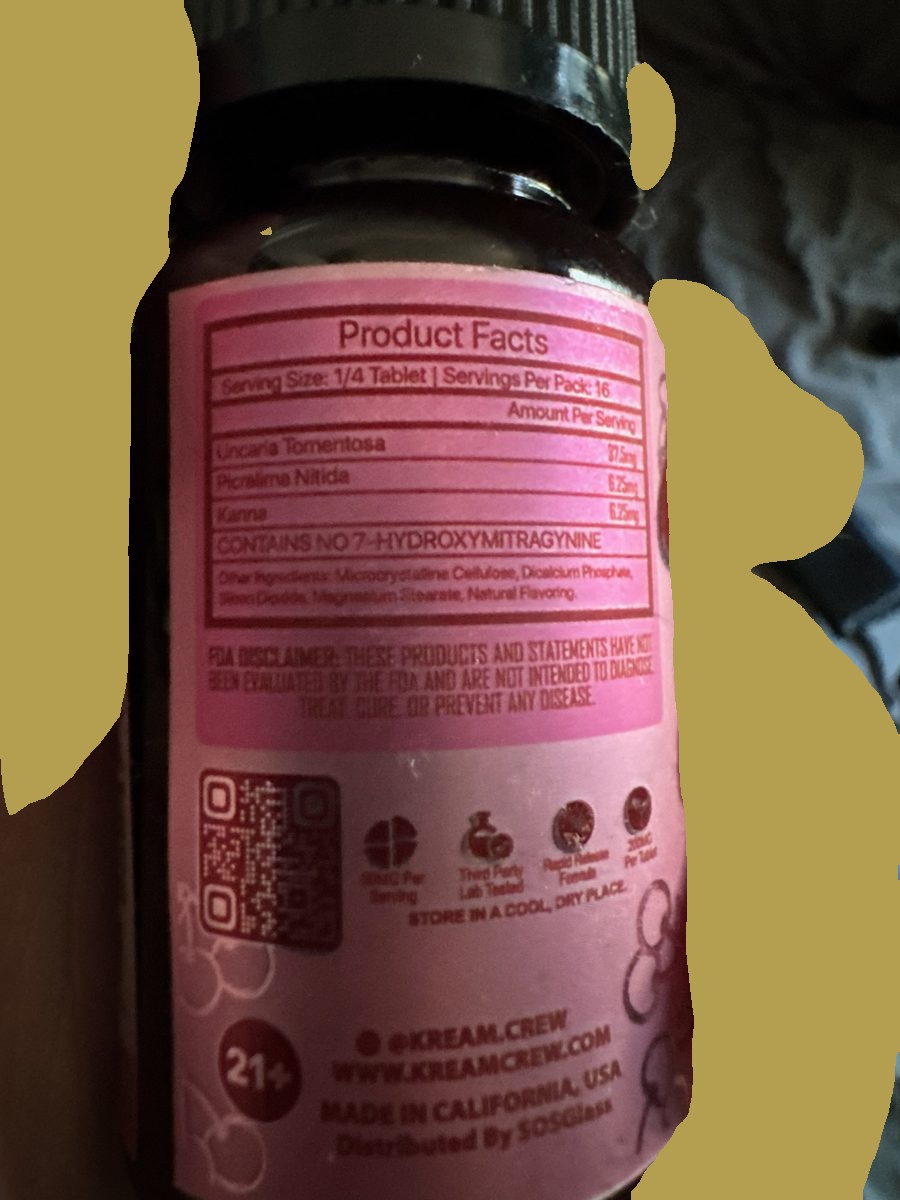
The front and back appear not to match. From the photos we received, the back seems to add up on its own: 37.5 + 6.25 + 6.25 is 50 mg per serving, four servings make 200 mg per tablet, and 16 servings would be four tablets, or 800 mg total. A badge on the front, though, appears to read "1000MG" over 200 mg per tablet. Glare in the photo hides part of that badge, so we can't be certain what it says. If it does mean 1000 mg in the bottle, that would be five tablets and 20 servings, not the 16 printed on the back.
One ingredient is an opioid-active plant. Picralima nitida is akuamma, a West African tree whose seeds are sometimes sold as a kratom alternative. Researchers who isolated its alkaloids found their main targets are opioid receptors. Several bind the mu-opioid receptor, the same receptor targeted by morphine and fentanyl, though only weakly, and one is a potent agonist at the kappa-opioid receptor (Creed et al., Journal of Natural Products). Small print on the front appears to call it "Picralima Nitida Extract," while the back lists it simply as Picralima nitida. An extract is concentrated, and the label gives no strength, so there's no way to know how much akuamma a serving actually delivers.
Could the akuamma be causing the problem? It's possible, and we can't rule it out. Akuamma is openly listed on the Kream label, so it wouldn't be a hidden ingredient. What's uncertain is how strong it is. In the same study, the akuamma alkaloids produced only weak, inconsistent pain relief in mice, far less than morphine. We found no published research on whether akuamma causes dependence or withdrawal in people, in either direction. The extract's unknown strength, and how many tablets someone actually takes, could matter a lot. One more detail: the Happy Daze label lists no akuamma or any other opioid-active ingredient, so akuamma alone wouldn't explain effects from that product.
Kanna works differently. Kanna (Sceletium tortuosum) is a South African plant whose main alkaloid, mesembrine, mainly blocks serotonin reuptake. We found no evidence that it acts on opioid receptors.
It denies 7-OH, and only 7-OH. The Product Facts box says "Contains no 7-hydroxymitragynine" in capital letters. Like Happy Daze, it's fair to ask why a blend of cat's claw, akuamma, and kanna needs to say that. None of those plants is related to kratom. And the statement says nothing about mitragynine pseudoindoxyl, MGM-15, or MGM-16, the compounds investigators actually found in fake cat's claw. The bottle is also marked "21+," one of the red flags Utah Poison Control lists.
Can a "no 7-OH" label still hide an opioid?
Yes. This is the main reason our caller's suspicion deserves to be taken seriously. When 7-OH became the target of state and federal bans, the market moved to close chemical relatives. A product can contain a meaningful dose of one of them and still truthfully print "0 PPM 7-hydroxymitragynine." A lab report that only tests for 7-OH and mitragynine would come back clean.
That's what Utah found. Labels on the products tied to deaths there often said the product was legal and kratom-free while warning that it was for adults only. Lab testing found compounds that weren't listed anywhere.
What are MGM-15 and mitragynine pseudoindoxyl?
They're opioid-acting compounds made from kratom alkaloids. The ones turning up in fake cat's claw include:
- 7-hydroxymitragynine (7-OH): the compound our caller was dependent on. See our explainer, 7-OH: The Dangerous Kratom Extract Alarming Health Officials.
- Mitragynine pseudoindoxyl (MGPI or MP): a chemical rearrangement of 7-OH that doesn't occur naturally in the kratom plant.
- MGM-15 (dihydro-7-hydroxymitragynine): a lab-made derivative of 7-OH. Our article MGM-15: Innocent Kratom Extract or Opioid? explains it in detail.
- MGM-16: another lab-made derivative.
For a side-by-side look at how these compare, see Kratom vs. 7-OH vs. MGM-15: What's the Difference?
In August 2026, the DEA temporarily placed mitragynine pseudoindoxyl, MGM-15, and MGM-16 in Schedule I. Our articles on the legal status of MGM-15 and the legal status of 7-OH track these changes. Our guide to drug schedules and controlled substances explains what that means.
Do these compounds show up on a drug test?
Not on a standard urine drug screen. Detecting them requires specialized lab testing. A negative test cup doesn't mean someone isn't taking an opioid.
Is cat's claw legal in Ohio?
Real cat's claw is a legal herbal supplement. The hidden compounds are not. Under an Ohio Board of Pharmacy rule, kratom-derived synthetic compounds, including 7-OH, mitragynine pseudoindoxyl, MGM-15, and 7-acetoxymitragynine, are Schedule I in Ohio. The rule took effect as an emergency order in December 2025 and became permanent in May 2026. Kratom extracts and tinctures are also banned, and blended kratom products have been banned since August 4, 2026. Natural kratom leaf is still legal (Ohio Board of Pharmacy). Our Ohio kratom ban explainer covers how the state got here. For Wisconsin, see Can I use 7-OH or kratom in Wisconsin?
A product sold in Ohio that secretly contained any of these compounds would be a Schedule I drug sold under a supplement label.
What we can and can't say about these two products
What we know: Both products lead with cat's claw, the ingredient name used on products that tested positive for hidden kratom-derived opioids elsewhere. Both go out of their way to deny 7-OH, though neither has any declared connection to kratom. Kream is marked "21+," declares an opioid-active plant extract of unknown strength, and from the photos, its front and back labels appear not to match. The Happy Daze panel uses kratom labeling language, and its vitamin percentages and footnotes are printed wrong.
What we don't know: What's actually in these tablets. We haven't seen lab results for either product, and no health department or poison center has named Happy Daze or Kream. The products could be exactly what their labels say, and the label details above may have ordinary explanations, such as printing or formatting errors. Our caller's experience is one person's account, though it comes from someone who knows what 7-OH feels like. We are reporting what he told us and what we observed, not reaching a conclusion about either product.
If either company has third-party lab results showing these products were tested for MGPI, MGM-15, MGM-16, and related compounds, we'd welcome seeing them, and we'd update this article.
Can you go through withdrawal from cat's claw tablets?
Real cat's claw shouldn't cause withdrawal. But if a product contains hidden opioid-like compounds, stopping it can bring on opioid-type withdrawal. The Virginia Department of Health lists dependence and opioid-like withdrawal among the reported effects of adulterated cat's claw products. Watch for these signs:
- A high, warm calm, or pain relief that seems stronger than an herbal supplement should produce
- Needing more over time to get the same effect
- Feeling sick, anxious, achy, sweaty, or restless when you skip a dose
- Cravings that never went away after you switched from 7-OH, kratom, or another opioid
Those are signs of physical dependence on something that acts like an opioid, whatever the label says. Switching from one substance to a similar one that feels safer or more legal is a form of cross addiction. If you've been taking these products daily, talk to a medical provider before stopping. Our article on quitting drugs cold turkey explains why stopping abruptly can be risky, and 7-OH Detox, Withdrawal, and Treatment describes what our clinicians see with these compounds. For what we've seen in our own admissions, read 7-OH Addiction: Real Data From Our Rehab.
If you think someone is overdosing
- Call 911 if someone can't be woken up or isn't breathing.
- Give naloxone (Narcan) if you have it. If these products contain hidden opioids, naloxone can reverse an overdose. Our Naloxone 101 guide explains how to use it.
- Call Poison Control at 1-800-222-1222 for a bad reaction or if you're not sure what was taken. It's free and open 24 hours a day.
Getting help
Whether it was sold as 7-OH, kratom, or cat's claw, what matters is how your body is reacting, not what the label says. Wellbrook Recovery offers full medical detox with 24/7 nursing care, followed by residential treatment at our programs in Chardon, Ohio and Brookfield, Wisconsin. If you're in Northeast Ohio, our inpatient drug rehab in Ohio is close to home. We aim for same-day admission, so you don't have to wait for a bed. If you're nervous about detox, our step-by-step guide on what to expect during medical detox walks through it.
Call (866) 972-1239Start Admissions
Ohio program: call our Chardon team directly at (440) 306-6667.
Frequently asked questions
Is cat's claw the same thing as kratom or 7-OH?
No. Genuine cat's claw (Uncaria tomentosa) is a South American vine sold as an herbal supplement. It isn't psychoactive and doesn't act like an opioid. The concern is with products labeled as cat's claw that contain hidden kratom-derived compounds.
Are Happy Daze or Kream products confirmed to contain hidden opioids?
Not as of this writing. Neither brand has been named by a health agency, and we haven't seen lab results for either one. This article is based on one caller's experience and a close reading of the labels he sent us.
What should I do if I think I'm dependent on one of these products?
Don't stop abruptly on your own if you've been using daily. Talk to a medical provider, or call us at (866) 972-1239. Medically supervised detox is the safest way through withdrawal.
Disclaimer: This article is for general education and is not medical or legal advice. It is based on one caller's personal account, our reading of product labels from photos we received, and publicly available reports about other products sold as cat's claw. Wellbrook Recovery has not tested Happy Daze or Kream products and makes no claim about what they contain. Brand names are used only to identify the labels discussed. If you have health concerns about a product you've taken, talk to a medical provider or call Poison Control at 1-800-222-1222.
Sources
- Utah Poison Control Center: Adulterated Cat's Claw and Kava Products May Cause Opioid Overdose (July 2026)
- Utah Department of Agriculture and Food: Illegal Kratom Product Sold in Utah County Linked to Death (July 30, 2026)
- TownLift: Utah officials renew warning after four deaths (October 2026)
- Virginia Department of Health: "Cat's Claw" Products Containing Unlabeled Kratom Alkaloids (September 2026)
- NewsChannel 9: TBI warns mislabeled cat's claw products may contain illegal kratom
- KIRO 7: Washington Poison Center warning on counterfeit cat's claw
- Becker's Behavioral Health: Cat's claw, explained (October 14, 2026)
- Ohio Board of Pharmacy: 7-OH and kratom rule notice
- FDA: Daily Value on the Nutrition and Supplement Facts Labels
- National Center for Complementary and Integrative Health: Cat's Claw
- Creed et al.: Isolation and Pharmacological Characterization of Six Opioidergic Picralima nitida Alkaloids (Journal of Natural Products)