We’ve been hearing so much about kratom and 7-OH recently. But as fast as kratom and 7-OH popped up on the market, another kratom derivative has appeared on the market: MGM-15.
MGM-15 is a chemical modification of 7-OH that acts like a standard opioid, and bears no resemblance to natural kratom, except that it is sold under the kratom umbrella. This convinces buyers that they are buying a ‘natural wellness’ supplement, while in reality, it’s a new, dangerous opioid.
What Is MGM-15?
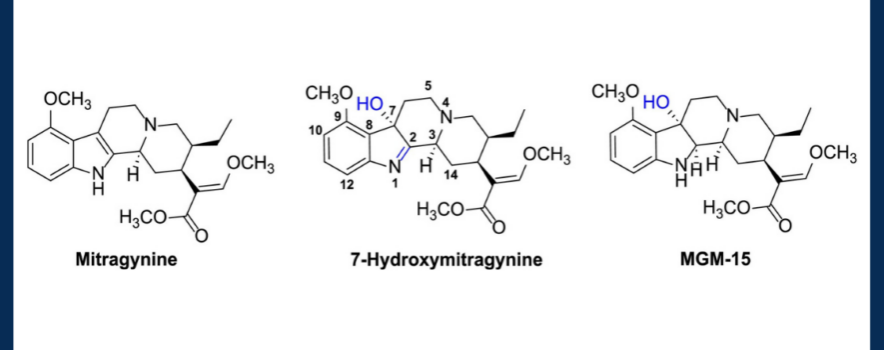
MGM-15, also known as dihydro-7-hydroxymitragynine, is a synthetic derivative of 7-OH. It’s created by chemically modifying 7-OH to increase its strength and potency. Structurally, MGM-15 is a modified version of 7-OH. It is a full opioid agonist, and binds to opioid receptors more strongly than 7-OH products.
MGM-15 was first lab synthesized in 2014. It became commercially available in 2025.
What’s the difference between kratom, 7-OH, and MGM-15?
Natural kratom is kratom leaf in any shape or form, often sold as capsules or brewed as teas. Its effects are relatively mild and are often compared to the effects of caffeine.
7-oh is a naturally occurring derivative of kratom leaf. However, it exists in such trace amounts in natural kratom that it needs to be synthetically produced. Its effects are significantly stronger than natural kratom, acting on the brain’s opioid receptors in a way that is more comparable to prescription painkillers than to caffeine.
MGM-15 is a semi-synthetic product, derived not from the kratom plant itself, but from the chemical structure of 7-OH. Its effects are those of a powerful opioid, and based on laboratory testing, it binds to opioid receptors even more strongly than 7-OH does.
Dr. Abhisheak Sharma, MPharm, PhD, Associate Chair and Assistant Professor at the University of Florida and one of the first researchers to publish on MGM-15, explains the chemistry: “Kratom is natural leaf, kratom extract is concentrated leaf product, 7-OH, is semi synthetic kratom, and MGM-15 is one step further than 7-OH.”

The false marketing of MGM-15
MGM-15 products are marketed as kratom products, but that is a dangerous perception. MGM-15 products have never seen a kratom leaf. Marketers are simply exploiting kratom’s popularity as a ‘wellness product’ and using it to market a dangerous designer drug, which happens to be chemically related to kratom.
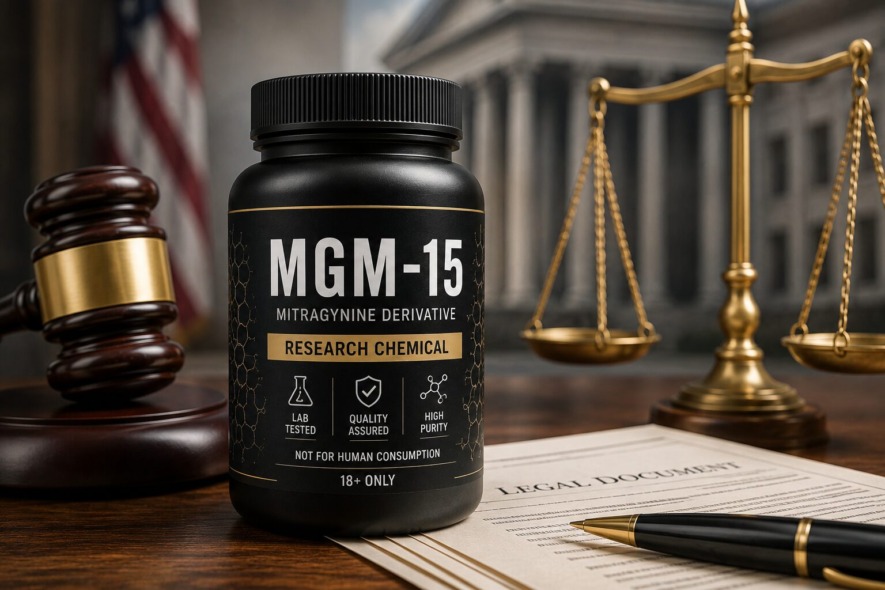
MGM-15 products are often labeled ‘for research purposes only’, or ‘not approved for human consumption’. This is the same trick that was used in nitazenes and synthetic cannabinoids until they were scheduled. (declared illegal) It is obvious from the rest of the marketing language that it is being sold to humans for recreational uses. As one website says bluntly “For regulatory purposes, Ritually Pure is providing this product as a research chemical only. It is not intended for human or animal consumption.”
Dr. Sharma points out that the “not for human consumption” label is a deliberate legal shield, not a genuine safety warning: “It’s the liability of who’s selling a product in the market to confirm whether the product is safe or not. What they do is just put a label that it’s not for human consumption to get rid of that liability.”
Where is MGM-15 sold?
MGM-15 is sold in online wellness stores and websites, in smoke shops, and of course, at the gas station.
How are MGM-15 products sold?
Products are offered in a range of flavors and forms, including isolate powders, tablets, and liquid shots, offering customers multiple options to choose from. At least one website notes that “gummies are coming soon”.
Who’s using MGM?
This is one of the biggest problems of MGM-15’s false marketing; because it’s being sold as a ‘wellness’ product; it’s not only opioid seekers that are using it.
MGM-15 is being marketed as a sleek “wellness” upgrade for busy professionals, gym-goers, and travelers — basically a synthetic opioid repackaged as a productivity and lifestyle supplement.
A website selling MGM-15 tablets purports that “by stripping away the “fringe” elements of botanical use, the taste, the mess, and the stigma, MGM-15 has successfully “mainstreamed” a powerful wellness tool.”
MGM-15 chemical properties
Is MGM-15 an opioid?
Yes. MGM-15 acts as an opioid agonist in the body and binds effectively to opioid receptors. MGM-15 works when swallowed. In animal studies, MGM-15 produces opioid effects. No dedicated human studies exist yet on MGM-15 specifically, but given its’ opioid qualities, all opioid related risks, such as dependence, addiction, and respiratory depression are expected.
Dr. Sharma explains what this means- “If a compound is showing respiratory depression in animals, there is 99.9% possibility that it is going to be problematic in humans. The only things that could change are the dose, the route of administration, and the formulation. There is no guesswork ….. It’s a clear-cut opioid and should not be in the market without FDA approval.”
How does MGM-15 compare to other opioids?
When tested in mice, MGM-15 exhibited 50 times greater potency than morphine when taken orally. MGM-15 was found to be 2.6 to 3.4 times stronger than traditional 7-OH. (From Kratom to Semi-Synthetic Opioids: The Rise and Risks of MGM-15)
In lab testing on human opioid receptors, MGM-15 binds more powerfully to both the mu and delta opioid receptors than 7-OH, the compound it was made from.
Dr. Sharma explained how they tested this: “We need to isolate opioid receptors from recombinant cell-based systems expressing human— mu, delta, kappa receptors. If a compound has an affinity to bind those opioid receptors, it will bind them and replace a radioligand. These receptor binding assays are gold standard — we need to do them at a very early stage to evaluate any compound.”
Is MGM-15 contaminated with other drugs?
Researchers who analyzed commercially available MGM-15 tablets found no contamination with fentanyl or other illicit substances. The danger is not that these products are laced with something else. The danger is MGM-15 itself.
MGM-15- addictive properties and withdrawal symptoms
Is MGM-15 addictive?
Yes! Because MGM-15 binds to opioid receptors, researchers suggest that it has the same addictive properties as opioids such as fentanyl and heroin. While human research studies haven’t yet researched MGM-15, the fact that it binds to these receptors is an indicator that it has the same properties as known opioids.
Additionally, because products are sold by unregulated suppliers, potency can vary significantly between batches, and users are unaware of how much they’re taking, making addiction possible in just a short amount of time.
Side effects of MGM-15 use
As the drug is new and emerging, much of the information available on the risks and side effects comes from online forums such as Reddit, with users reporting. They discuss side effects such as violent muscle spasms, excessive sweating, and “blackout” experiences following the ingestion of MGM-15. They also talk about sore throats and respiratory issues, alongside concerns that these substances may be more reinforcing and harder to cease than traditional kratom leaf. (from NDEWS MGM-15 alert)
MGM-15 withdrawal symptoms
Withdrawal symptoms of MGM-15 are scarcely documented. However, based on the opioid receptor binding properties that it has, one would imagine that withdrawal mimics those of other opioids.
That includes:
- Agitation
- Anxiety
- Muscle aches
- Increased tearing
- Insomnia
- Runny nose
- Sweating
- Yawning
Late symptoms of withdrawal include:
- Abdominal cramping
- Diarrhea
- Dilated pupils
- Goosebumps
- Nausea
- Vomiting
Can you overdose on MGM-15?
Given MGM-15’s opioid properties, it is expected to carry the classic opioid risks of overdose, respiratory depression, and death.
NDEWS Co-Investigator and Sentinel Site Director Bruce Goldberger reports that MGM-15 is showing up in death investigations in Florida. Not just can you overdose on MGM; it has already been involved in deaths.
Is MGM-15 legal?
In early July, the DEA filed a notice of intent to federally schedule MGM-15. The rule is set to take effect on or after August 5, 2026. Once it takes effect, MGM-15 will be illegal in all areas of the United States.
On a state level, several states have scheduled MGM-15, and others have taken steps to restrict sales. See the legal status of MGM-15 for more details.
Is MGM-15 included in kratom bans?
In many states that ban kratom and/or 7-OH products, bans include mitragynine derivatives and synthetic kratom compounds. That means MGM-15 could potentially fall under some of those broader definitions depending on how the statute is written and interpreted.
MGM-15 is being used to skirt kratom regulations
Dr. Sharma explains why MGM-15 is specifically designed to evade existing bans: “They [the MGM-15 manufacturers] reduce the 7-OH and convert it to its 1-2 dihydro form. So, if you test it [MGM-15], any state agency that scheduled 7-OH, the product [MGM-15] will still get through because there’s no 7-OH in it.”
In online forums such as Bluelight, people discuss using MGM-15 to get around 7-OH restrictions in their states, highlighting the legal ambiguity and how fast new drugs appear on the market, way before regulators and health officials catch on.
What to do next
Dr. Sharma argues that despite a lack of human studies, just the knowledge that MGM-15 has opioid activity, and it has not gone through the FDA approval process, it is enough to have the emergency scheduled. “With the minimal available resources, we can confirm that it is binding to opioid receptors. That is enough. This is an opioid and that product should not be in the market without appropriate safety evaluation. Why should we wait until it becomes a public health crisis?”
FAQs About MGM-15
MGM-15 is a synthetic opioid derived from 7-OH, a compound found in trace amounts in the kratom plant. It was first synthesized in a laboratory in 2014 and began appearing in U.S. consumer markets in 2025. Despite being sold as a kratom product, it acts on the same opioid receptors as morphine and heroin.
Yes. MGM-15 is a full agonist at both the mu and delta opioid receptors, meaning it fully activates them rather than partially. This is significant because full agonists produce the maximum possible opioid effect at those receptors — the same mechanism as heroin and fentanyl — including euphoria, pain relief, and respiratory depression. This was confirmed in laboratory testing using human opioid receptor cell lines, with naltrexone reversal validating the opioid mechanism. (Gour et al., 2025)
No. Kratom is a plant. MGM-15 is a synthetic opioid created in a laboratory — commercially tested tablets contained no naturally occurring kratom alkaloids whatsoever. Calling MGM-15 a kratom product is a marketing strategy, not an accurate description of what it is.
No. 7-OH is a naturally occurring compound found in kratom leaf that is artificially concentrated for sale. MGM-15 is a further chemical modification of 7-OH made in a laboratory to increase its potency, and in testing on human opioid receptors it was found to be 2.6 times stronger than 7-OH at the mu receptor and 3.4 times stronger at the delta receptor.
When tested in mice, MGM-15 showed approximately 50 times greater potency than morphine when taken orally. No human potency studies exist yet, but its receptor profile indicates significant opioid strength well beyond natural kratom leaf.
Yes. MGM-15 is a full opioid agonist that fully activates the same receptors targeted by morphine, heroin, and fentanyl. Researchers confirmed this using naltrexone, a standard opioid blocker, which reversed MGM-15’s effects.
Yes. MGM-15 fully activates opioid receptors and researchers conclude it carries the same addictive potential as other opioids. The risk is compounded by unregulated supply chains where potency varies significantly between batches, meaning users may be taking far more than they intend to.
Based on user reports documented by the National Drug Early Warning System, side effects include violent muscle spasms, excessive sweating, blackout experiences, sore throat, and respiratory issues. Users also report that MGM-15 is more reinforcing and harder to stop than traditional kratom leaf.
Because MGM-15 is a full opioid agonist, withdrawal is expected to mirror opioid withdrawal syndrome, which includes agitation, anxiety, muscle aches, insomnia, and sweating in the early phase, followed by nausea, vomiting, cramping, and diarrhea in the later phase. NDEWS also documents reports of precipitated withdrawal — a sudden severe onset of symptoms — among MGM-15 users.
Yes. MGM-15 carries the same overdose risks as other opioids, including respiratory depression and death. NDEWS has reported that MGM-15 is already showing up in death investigations in Florida — this is a documented risk, not a theoretical one.
Researchers who analyzed commercially available MGM-15 tablets tested for fentanyl, oxycodone, buprenorphine, and a full panel of illicit substances and found none. The danger posed by MGM-15 is not contamination — it is MGM-15 itself.
MGM-15 is set to be federally scheduled on or after August 5, 2026. It will then be illegal across the United States.
Because kratom has an established reputation as a natural wellness product, and that reputation is commercially valuable. By marketing MGM-15 under the kratom umbrella, vendors reach consumers who would never consider buying a synthetic opioid — the same strategy used to market synthetic cannabinoids and bath salts before they were scheduled.
Because MGM-15 is marketed as a ‘wellness’ supplement, it is reaching well beyond people seeking opioid effects. It is being actively marketed to professionals, gym-goers, and travelers as a productivity and lifestyle supplement, which is one of the most significant public health concerns surrounding the product.
Are you ready to be given a new chance at health and happiness? Be your true best self? Has going it alone not been working? Perhaps you’re concerned about a loved one and want to support them in obtaining the help they need to get better?
Wellbrook Recovery has extensive experience and expertise assisting individuals with all types of substance abuse struggles. Providing compassionate and cutting-edge, multi-pronged addiction recovery care at our beautiful, upscale facilities.
Our highly regarded, expert team of multi-licensed therapists and specialists will make your success their own and will hold your hand throughout, regardless of where you currently at. We’ve done it hundreds of times, helping individuals and families reclaim their lives, their confidence, and their smiles.
Just reach out.
We’ll walk you through the simple admission process and answer any and all questions.
We understand that addiction affects everyone differently, which is why we offer a range of treatment options designed to meet your individual needs. Our treatment center provides the following programs:
Drug & Alcohol Detox: Detoxification is often the first step in recovery. Our facility provides medically supervised detox to help clients safely manage withdrawal from drugs or alcohol in a supportive environment.
Inpatient Drug Rehab: Inpatient treatment offers a structured environment so clients can focus on recovery free from distractions. It’s ideal for those at the beginning of their recovery journey who need intensive, around-the-clock care to overcome addiction.
Day rehab – Partial Hospitalization Program (PHP): As clients transition from inpatient care to a more independent lifestyle, PHP gives them the support they need as they continue on their road to recovery. By spending much of the day in rehab but the evenings at home, clients reinforce the life and recovery skills they learned during inpatient treatment.
Outpatient Treatment Programs (Day/Evening): For those who need more flexibility, outpatient programs allow clients to continue living at home while attending treatment on a part-time basis.
Wellbrook Recovery believes in treating the whole person, not just the addiction. Our services go beyond detox and inpatient care to ensure a complete recovery process:
- Mental Health Support: Addiction often co-occurs with mental health disorders such as anxiety, depression, trauma and PTSD. Our team of mental health professionals works closely with clients to treat both the addiction and any underlying mental health issues.
- Behavioral Therapy: We utilize proven behavioral therapies such as CBT, DBT, IFS, EMDR, Biofeedback, Music Therapy, Art Therapy, among other advanced therapies to help individuals address the root causes of addiction, develop coping skills, and make lasting changes in their lives.
- Support Groups: Our support groups provide individuals with the opportunity to connect with others who are going through similar struggles. Peer support is an essential part of the recovery journey.
- Family Programs: Addiction impacts not only the individual but also their loved ones. Our family programs educate and support families, helping them to rebuild relationships and provide ongoing support.
- Alumni & Aftercare: We have a network of our close-knit alumni community, with events and support to stay in touch with your recovery and “battle brothers & sisters” from your time in treatment.